
Tarot spreads are powerful tools for uncovering hidden insights and understanding unconscious processes within ourselves. A spread arranges cards into a pattern that tells a story, providing guidance, clarity, and answers to pressing questions. The approach and mindset of the reader can greatly influence the outcome of a reading.
Start your tarot practice in a calm, receptive state. Avoid over-analysing; open yourself to spiritual messages, which often appear in intuitive or symbolic forms. Meditation or ritual can help achieve this state of focus, making your readings more accurate and meaningful.
Spreads reveal hidden factors about a situation and can be adapted to specific questions or decisions. Each card carries symbolism that interacts with surrounding cards, giving context and deeper meaning.
The following list presents a range of tarot spreads for exploring consciousness. Developed by tarot experts over time, these layouts offer reliable guidance. While designed for tarot, many can also be applied to other oracle decks.
Simple Spreads
One-Card Tarot Reading
Difficulty: Easiest
A single-card reading provides concise insight or a focus for the day. Suitable for meditation, general guidance, or direct questions. It can be used repeatedly, drawing one card at a time to reveal an evolving story.
Three-Card Tarot Spread
Difficulty: Very Easy
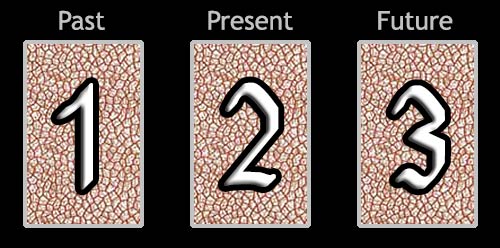
This spread highlights past influences, current circumstances, and near-future developments. Use it for Past/Present/Future readings or any three-part question.
The Blind Spot
Difficulty: Varies
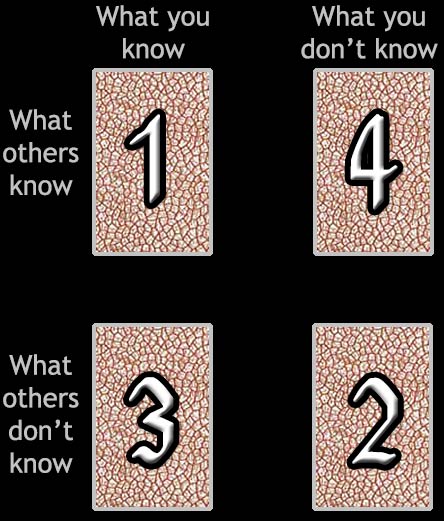
Designed to enhance self-awareness. Useful for uncovering hidden aspects of oneself.
- Card 1: Obvious identity; what is consciously known and displayed.
- Card 2: Unconscious forces; hidden drivers of behavior.
- Card 3: Concealed traits; what is kept from others.
- Blind Spot: The key area of focus the spread reveals.
The Cross Tarot Spread
Difficulty: Easy
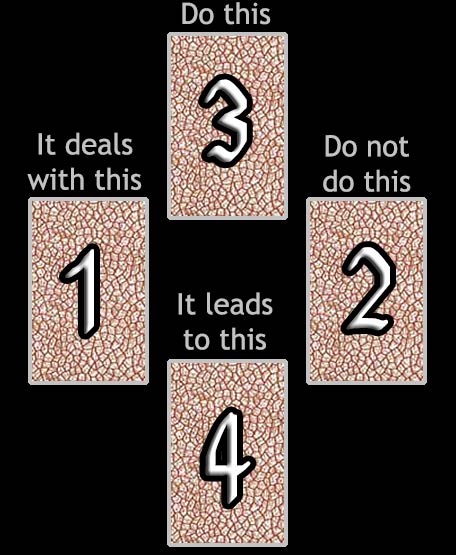
Ideal for questions, guidance, or clarifying confusing cards.
- Card 1: Topic
- Card 2: Distinguishes meaning vs Card 3
- Card 3: Clarifies meaning
- Card 4: Result
Use this spread to resolve uncertainties or examine advice, focusing on the contrast between Cards 2 and 3.
The Horse Shoe Tarot Spread
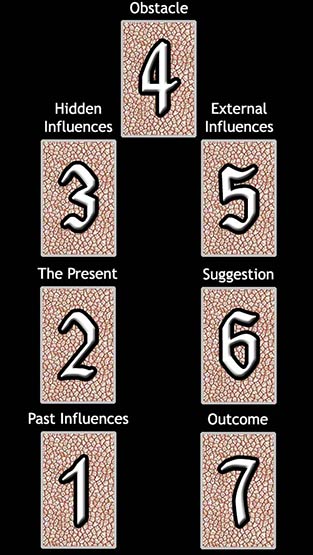
Difficulty: Easy
More advanced than three-card spreads but versatile for most questions.
- Past – events influencing the query
- Present – current situation
- Hidden Influences – unnoticed factors
- Obstacles – challenges to overcome
- External Influences – surrounding people or events
- Suggestions – recommended actions
- Outcome – results of following advice
The Ankh Tarot Spread
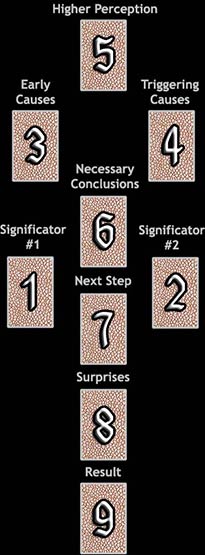
Difficulty: Moderate
Focuses on the causes behind trends or situations. The loop at the top reveals spiritual context, while the stem at the bottom predicts outcomes.
1–2. Parent causes of the situation
3. Early influences
4. Triggering factors
5. Spiritual perspective
6. Reasons for the situation
7. Next step
8. Surprises
9. Outcome
The Celtic Cross
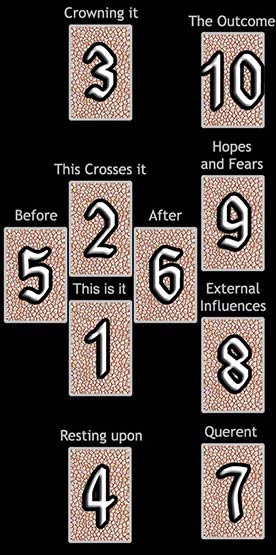
Difficulty: Average
The classic spread for beginners and advanced readers alike. Reveals relationships between cards and aspects of a situation.
- Card pairings to watch: #5 & #9, #1 & #2, #3 & #4, #6 & #10
- Card 1: Significator
- Card 2: Added impulse
- Card 3: Conscious thoughts
- Card 4: Unconscious drives
- Card 5: Immediate past
- Card 6: Near future
- Card 7: The reader’s perspective
- Card 8: External influences
- Card 9: Hopes/fears
- Card 10: Long-term outcome
Secret of the High Priestess
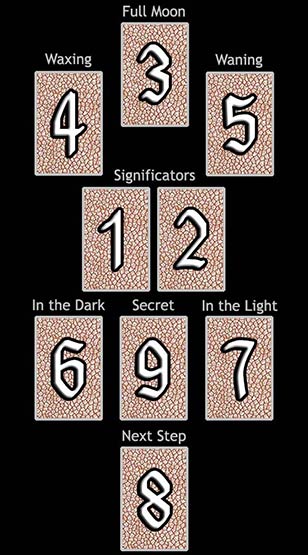
Difficulty: Average
Alternative to the Celtic Cross, focusing on current trends and potential secrets.
1–2. Main impulses of the topic
3. Current influence
4. Waxing Moon – upcoming influence
5. Waning Moon – past influence
6. Dark – hidden, deeper aspects
7. Light – clearly recognised elements
8. Next Step – immediate future
9. Secret of the High Priestess – special message (Major Arcana only)
Comic Strip Spread
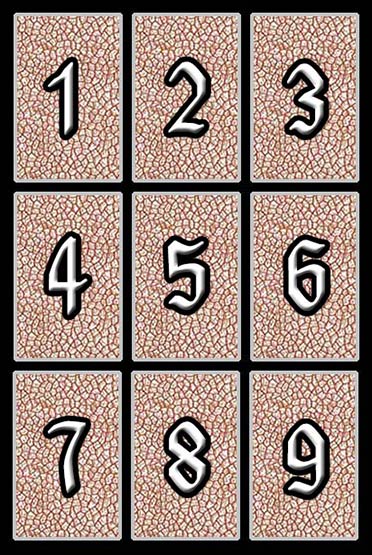
Difficulty: Easy
Nine-card chronological spread, ideal for scene-based decks. Treat like a storyboard to reveal future progression.
- Pay attention to card relationships and orientations.
- Focus on interactions to interpret narrative flow.
Relationship Spread #1
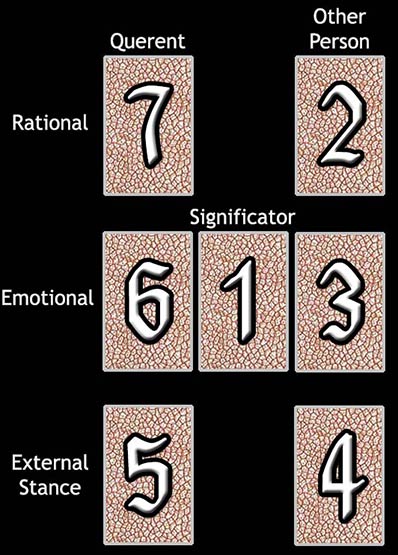
Difficulty: Easy
Charts dynamics between two individuals or groups.
- Card 1: Overall significator
- Top row: conscious thoughts (#7 & #2)
- Middle row: emotional awareness (#6 & #3)
- Bottom row: behaviors (#5 & #4)
Relationship Spread #2
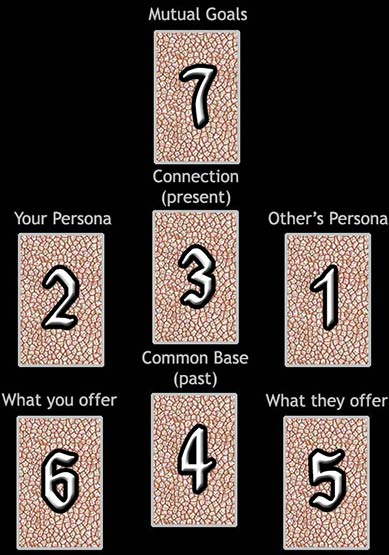
Difficulty: Easy
Focuses on common ground and individual contributions.
- Middle column: past, present, future (#4, #3, #7)
- Side columns: partner influences (#1, #2, #5, #6)
Advanced Tarot Spreads
The Love Triangle
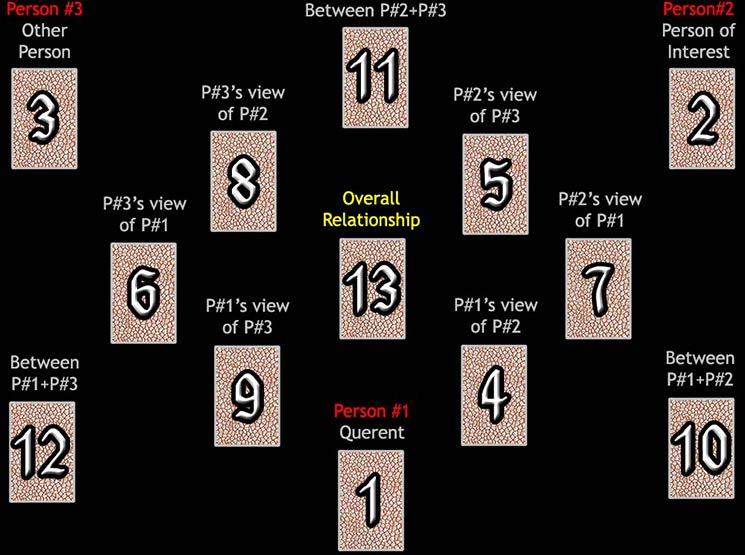
Difficulty: Complex
Explores three-person dynamics. Formed as a hexagram of triangles:
- Reader
- Main person of interest
- Third person
6–9. Relationships between individuals
10–13. Upward triangle shows potential outcomes - Overall significator
The Decision

Difficulty: Easy
Evaluates the consequences of a single option.
- Card 7: Overall theme
- Cards 3, 1, 5: Sequence if action taken
- Cards 4, 2, 6: Sequence if action avoided
The Path
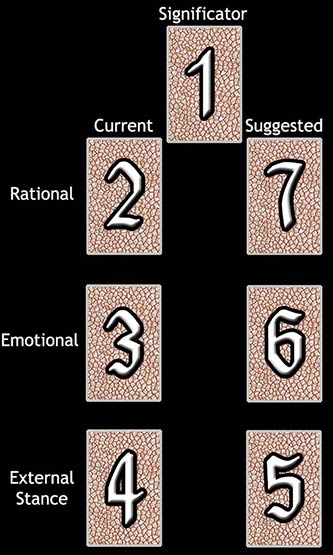
Difficulty: Easy
Offers guidance for proper action to achieve desired results.
- Current column: how you act now
- Suggested column: how to act for best outcome
- Cards represent Rational, Emotional, External Stance
The Game Plan
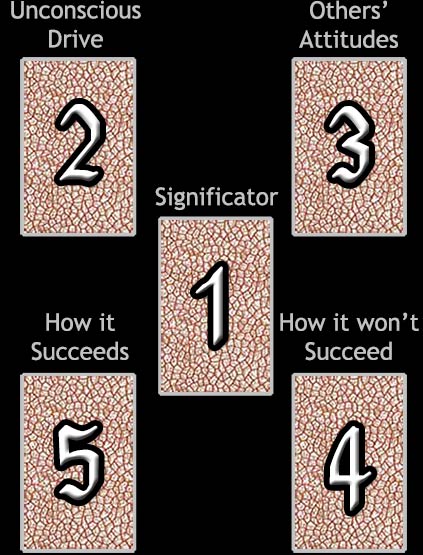
Difficulty: Easy
Five-card layout to evaluate plans and choices.
- Significator – central theme
- Drives/motivations (often unconscious)
- Others’ perception
- What to avoid
- Advice for success
Astrological Tarot Spread
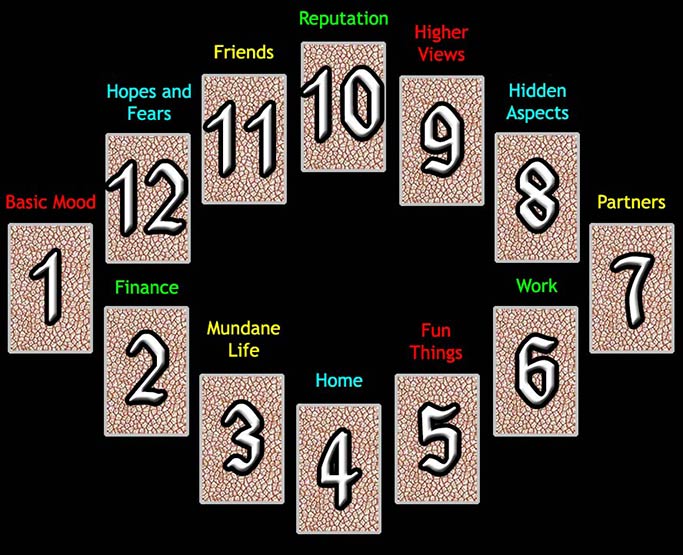
Difficulty: Complex
Based on astrology houses and triads:
- Fire: #1, #5, #9 – temperament
- Earth: #2, #6, #10 – material matters
- Air: #3, #7, #11 – thoughts/connections
- Water: #4, #8, #12 – emotions/intuitions
- Examine axes and number correlations for deeper meaning
The Three Pyramids
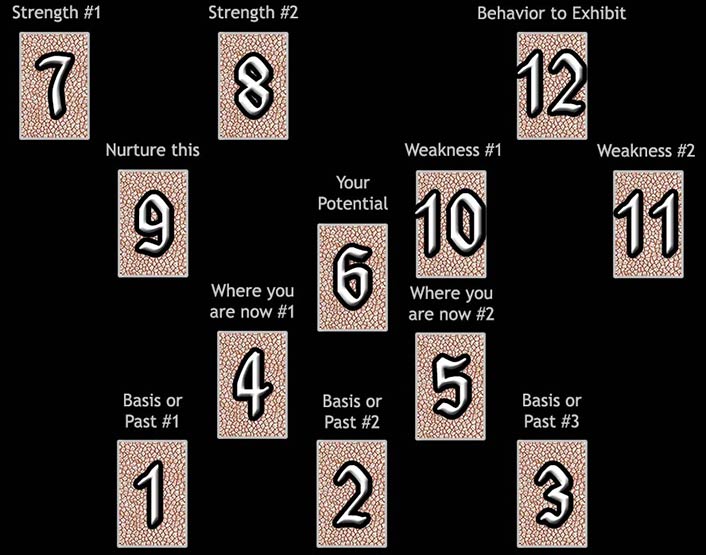
Difficulty: Complex
Central pyramid and two side pyramids (one inverted).
- 1 & 3: Past influences
- 4 & 5: Present self
- 6: Potential self
- 7 & 8: Strengths
- 9: Personal creation or gifts
- 10 & 11: Areas for growth
- 12: Offering to the world
The Golden Dawn Spread
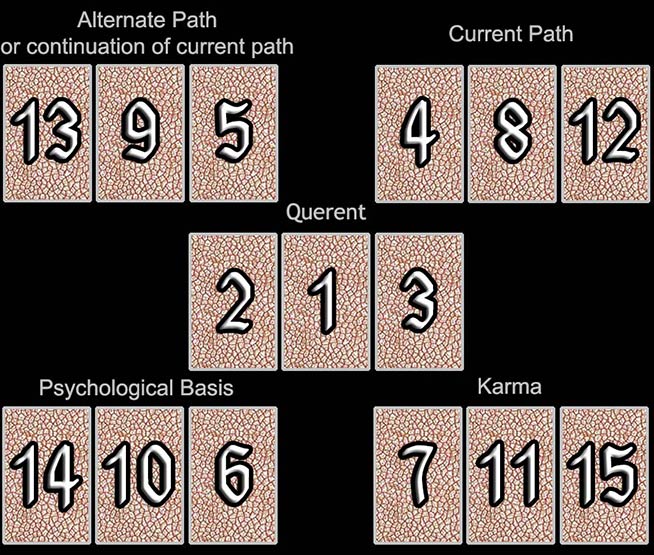
Difficulty: Complex
Designed for decks emphasising elemental dignities.
- Court cards: people; Princes/Queens: actual individuals; Princesses: ideas; Knights: arrivals/departures
- Pay attention to suits for dignities: same suits strengthen, opposite suits weaken
- Patterns in numbers and suits reveal hidden messages
- Card positions:
- Reader/topic
2–3. Extend understanding of topic
4, 8, 12. Current path
13, 9, 5. Alternate path
14, 10, 6. Psychological undertones
7, 11, 15. Karma and destiny influences
Waite’s Full-Deck Reading Method
The Full-Deck Waite Method (Two Operations)
Adapted from A. E. Waite’s Pictorial Key to the Tarot
Instructions for use on Rider-Waite.com
Overview
The full-deck method is the most advanced and complex of all tarot spreads described by A. E. Waite. It is not a simple fortune-telling layout but a true occult method of self-revelation and symbolic dissection of the psyche. In its full form, it consists of ‘operations’ that unfold progressively, each one a key that opens deeper strata of meaning.
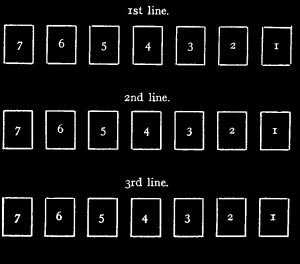
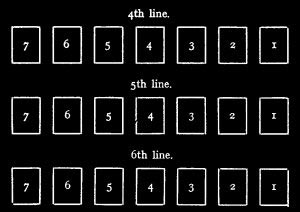
We simplify this complex method into two operations, preserving the spirit and core mechanics of Waite’s design while making it usable for modern digital divination. The first operation forms a 6×7 grid of 42 cards, revealing the fundamental structure of the matter. The second operation continues with the remaining 35 cards, allowing you to explore what remains unresolved or obscured after the first revelation.
To perform this spread correctly, you must first complete the First Operation in full before proceeding to the Second. The two are sequential, not interchangeable. The first builds the foundation; the second draws meaning from what lies beyond it.
The First Operation: The 42-Card Method
- Significator Selection
The querent is identified with a chosen significator card: traditionally, the Magician for a male querent or the High Priestess for a female querent. This card represents the self or the conscious agent within the spread. - Cut and Deal
After shuffling, the deck is cut (or randomly selected by the system). The cards are then dealt into six packets of seven cards each, representing six dimensions or ‘doors’ into the situation.- Packet I: Matters of the querent’s environment and immediate life.
- Packet II: The inner self and mental states.
- Packet III: Outer influences and events.
- Packet IV: Surprises and unknown variables.
- Packet V: Consolation or moderation—forces of balance.
- Packet VI: Hidden synthesis and esoteric meaning.
- The 6×7 Grid
The six packets are placed in rows, forming a grid of 42 cards. This grid is read both horizontally and vertically, tracing patterns of element, suit, and number. Here, this stage is automated and visualised directly. Read the lines as you would read threads of destiny, moving from top to bottom and left to right. Observe symmetries, oppositions, and the flow of reversed cards. - Interpretation
The first operation should be read as a complete story. Each line stands for an aspect of life, and together they outline the querent’s entire energetic situation. In traditional practice, this phase alone may suffice to complete the consultation.
The Second Operation: The 35-Card Method
The second operation begins only when the first is complete and something remains ambiguous or unresolved. It is a deeper key—an act of continuation, not repetition.
Preparation
- Set aside the first 43 cards, including the significator and the 42 used in the first operation.
- The remaining 35 undealt cards form the material of the second operation.
Division into Six Unequal Packets
The 35 cards are dealt into six packets, this time of unequal length, as follows:
- Packet I: 7 cards
- Packet II: 6 cards
- Packet III: 5 cards
- Packet IV: 4 cards
- Packet V: 2 cards
- Packet VI: 11 cards
These numbers are not arbitrary; they express the breaking of symmetry and the descent into the unknown, where order gives way to revelation.
Laying Out the Lines
Each packet becomes one line of the spread, forming six lines of unequal length. These lines are read as follows:
- First Line: The house or immediate environment—the material plane.
- Second Line: The person or the question itself—the conscious self.
- Third Line: External forces—people and events outside the querent’s control.
- Fourth Line: The unexpected or the hidden—the forces of surprise.
- Fifth Line: Consolation, hope, and spiritual moderation.
- Sixth Line: The key of interpretation, used to decode the enigmas of the others.
Reading the Second Operation
This phase is an act of refinement and revelation. Here the story grows stranger and more precise. The unequal rows suggest imbalance and movement; the longer lines carry emphasis, the shorter ones serve as clarifiers. The Sixth Line acts as the oracle key, unlocking meaning within the others.
The first operation reveals what is known.
The second operation uncovers what must still be known.
Notes on Simplification
Waite’s original method involved physical packets, counting, and element-based sub-readings. This site condenses the essence of the process, preserving the internal logic and sequential sequence of revelation while removing the excessive arithmetic and manual sorting that made the original ritual cumbersome.
Here, both operations follow Waite’s occult logic but are automated so that:
- Cards are properly shuffled, cut, and distributed into packets.
- The significator is identified and set aside, never duplicated in the grid.
- Reversals are treated as real symbolic inversions, not random noise.
- Each step of the operation is recorded in sequence, allowing you to review the process just like you were performing it manually.
- The transition from the first to the second operation happens only when the querent consciously chooses to continue. This preserves the divinatory rhythm of question → revelation → refinement.
Practical Reading Notes
- The First Operation establishes the visible situation: all that can be directly observed or reasoned.
- The Second Operation explores what remains uncertain: motives, hidden influences, and potential resolutions.
- Never skip ahead. The integrity of the reading depends on sequential revelation.
- When the second operation begins, read the cards from left to right.
- The final line of the second operation serves as your interpretive cipher; meditate on its relation to the entire spread.
This method originates with Arthur Edward Waite, described in The Pictorial Key to the Tarot (1910), Part III, Section 8 and 9. The adaptation here preserves the internal numerological and esoteric structure of Waite’s operations while rendering them operable within a digital framework.
We present this version as both a faithful modernisation and a functional occult tool, a living symbolic mechanism. It remains one of the deepest forms of tarot divination ever conceived, offering a map of consciousness as intricate as the Tree of Life itself.
Definition and Interpretation Notes
A tarot spread is a template for interpreting card positions. Each card is read in context, including influences from adjacent cards.
Elemental Dignity vs. Reversals:
- Dignities assess how adjacent cards affect a card’s energy.
- Same suit strengthens, opposite suit weakens. Neutral suits have no effect.
- Major Arcana may be exempt.
- Rider-Waite-inspired decks use reversals instead of dignities.
- Reversals show orientation (upright/reversed) and influence meaning.
- Historically, reversals were introduced by Etteilla in 1770.
Readers may adapt spreads, use or ignore dignities, and follow personal intuition. Guidelines here provide a framework, not strict rules. Practice and observation are key to mastery.
This page was adapted from the spreads page of tarotsmith.com. To see the original page, go here.