
Cross Spread
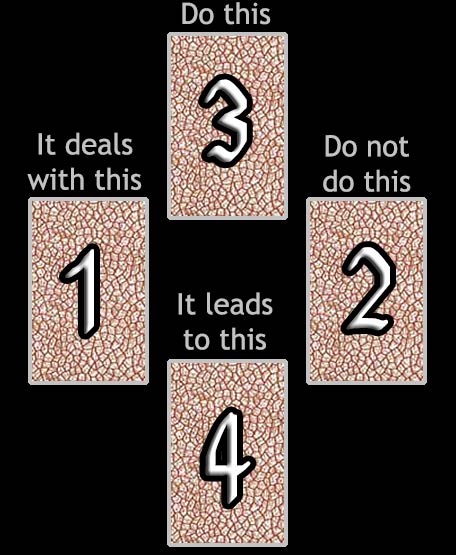
Difficulty: Easy
The Cross Spread is good for questions asking for advice. It can also be used to determine the meaning of a confusing card from a previous reading, or for that matter, to shed light on other points of confusion as well.
In questions asking advice, this spread is self-explanatory. The main thing is to determine the difference between cards #2 and #3. #1 is the topic and #4 is the result.
In questions regarding confusion, such as: “What was the meaning of Card (X) in the last spread?” the main thing is also to determine the difference between cards #2 and #3. In this case, Card #2 will show what the card was not referring to, and Card #3 will show what the card really meant. #1 is the topic and #4 represents the purpose it serves.
Your Cross Reading
DO This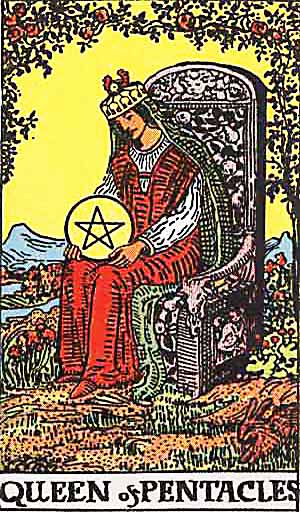 Queen of Pentacles |
||
It Deals with This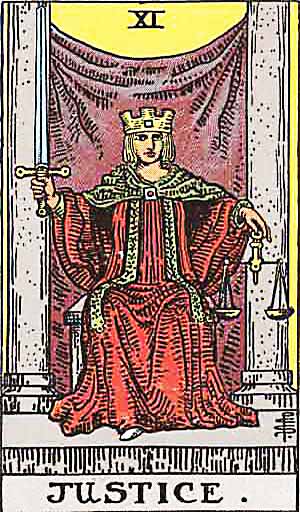 Justice |
Do NOT Do This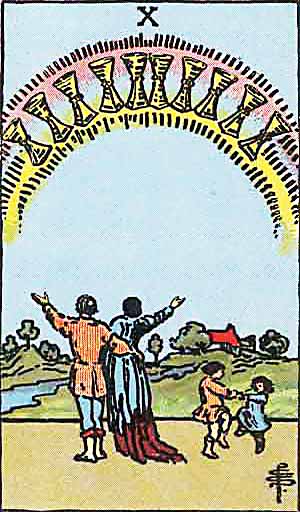 10 of Cups |
|
It Leads to This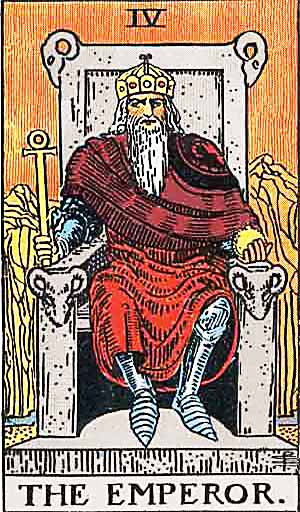 The Emperor |
It Deals with This
Justice
The figure is seated between pillars, like the High Priestess, and on this account it seems desirable to indicate that the moral principle which deals unto every man according to his works – while, of course, it is in strict analogy with higher things; – differs in its essence from the spiritual justice which is involved in the idea of election. The latter belongs to a mysterious order of Providence, in virtue of which it is possible for certain men to conceive the idea of dedication to the highest things. The operation of this is like the breathing of the Spirit where it wills, and we have no canon of criticism or ground of explanation concerning it. It is analogous to the possession of the fairy gifts and the high gifts and the gracious gifts of the poet: we have them or have not, and their presence is as much a mystery as their absence. The law of Justice is not however involved by either alternative. In conclusion, the pillars of Justice open into one world and the pillars of the High Priestess into another.
Divinatory Meaning:
Equity, rightness, probity, executive; triumph of the deserving side in law.
Do NOT Do This
10 of Cups
Appearance of Cups in a rainbow; it is contemplated in wonder and ecstasy by a man and woman below, evidently husband and wife. His right arm is about her; his left is raised upward; she raises her right arm. The two children dancing near them have not observed the prodigy but are happy after their own manner. There is a home-scene beyond.
Reversed Meaning:
Repose of the false heart, indignation, violence.
DO This
Queen of Pentacles
The face suggests that of a dark woman, whose qualities might be summed up in the idea of greatness of soul; she has also the serious cast of intelligence; she contemplates her symbol and may see worlds therein.
Divinatory Meaning:
Opulence, generosity, magnificence, security, liberty.
It Leads to This
The Emperor
He has a form of the Crux ansata for his sceptre and a globe in his left hand. He is a crowned monarch – commanding, stately, seated on a throne, the arms of which axe fronted by ram heads. He is executive and realisation, the power of this world, here clothed with the highest of its natural attributes. He is occasionally represented as seated on a cubic stone, which, however, confuses some of the issues. He is the virile power, to which the Empress responds, and in this sense is he who seeks to remove the Veil of Isis; yet she remains virgo intacta.
It should be understood that this card and that of the Empress do not precisely represent the condition of married life, though this state is implied. On the surface, as I have indicated, they stand for mundane royalty, uplifted on the seats of the mighty; but above this there is the suggestion of another presence. They signify also – and the male figure especially – the higher kingship, occupying the intellectual throne. Hereof is the lordship of thought rather than of the animal world. Both personalities, after their own manner, are full of strange experience, but theirs is not consciously the wisdom which draws from a higher world. The Emperor has been described as (a) will in its embodied form, but this is only one of its applications, and (b) as an expression of virtualities contained in the Absolute Being – but this is fantasy.
Reversed Meaning:
Benevolence, compassion, credit; also, confusion to enemies, obstruction, immaturity.