
Decision Spread

Difficulty: Easy
This simple but highly useful spread calls for a question to be asked in this format:
“What happens if I do (X), and what happens if I do not do (X)?“
Please note that it should not be viewed as a decision between 2 different options, but about whether or not a single option should be exercised. A second option would call for a separate reading.
Card #7 is the significator, the overall theme of the query.
Cards #3, #1, & #5 represent the chronological sequence of events that occurs if you choose to do (X).
Cards #4, #2, & #6 represent the chronological sequence of events that unfolds if you choose NOT to do (X).
Your Decision Reading
The Significator 2 of Pentacles |
Outcome if you do it: | ||
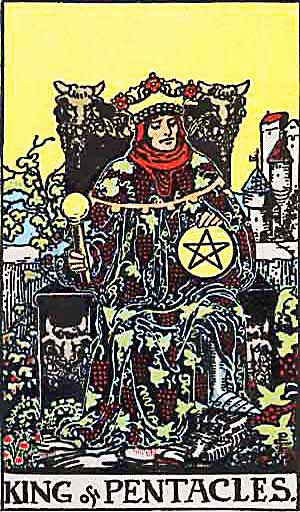 King of Pentacles |
 10 of Wands |
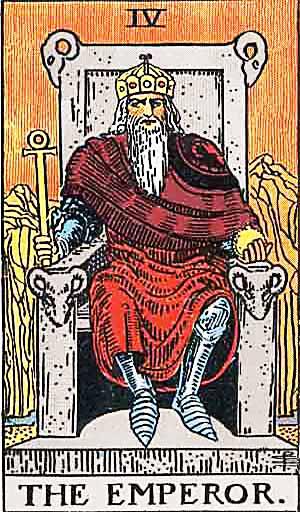 The Emperor |
|
| Outcome if you don't do it: | |||
 The Lovers |
 3 of Cups |
 Page of Pentacles |
|
2 of Pentacles
A young man, in the act of dancing, has a pentacle in either hand, and they are joined by that endless cord which is like the number eight reversed.
Divinatory Meaning:
On the one hand it is represented as a card of gaiety, recreation and its connexions, which is the subject of the design; but it is read also as news and messages in writing, as obstacles, agitation, trouble, embroilment.
Outcome if you do it:
King of Pentacles
The figure calls for no special description – the face is rather dark, suggesting also courage, but somewhat lethargic in tendency. The bull's head should be noted as a recurrent symbol on the throne. The sign of this suit is represented throughout as engraved or blazoned with the pentagram, typifying the correspondence of the four elements in human nature and that by which they may be governed. In many old Tarot packs this suit stood for current coin, money, deniers. I have not invented the substitution of pentacles and I have no special cause to sustain in respect of the alternative. But the consensus of divinatory meanings is on the side of some change, because the cards do not happen to deal especially with questions of money.
Reversed Meaning:
Vice, weakness, ugliness, perversity, corruption, peril.
10 of Wands
A man oppressed by the weight of the ten staves which he is carrying.
Reversed Meaning:
Contrarieties, difficulties, intrigues, and their analogies.
The Emperor
He has a form of the Crux ansata for his sceptre and a globe in his left hand. He is a crowned monarch – commanding, stately, seated on a throne, the arms of which axe fronted by ram heads. He is executive and realisation, the power of this world, here clothed with the highest of its natural attributes. He is occasionally represented as seated on a cubic stone, which, however, confuses some of the issues. He is the virile power, to which the Empress responds, and in this sense is he who seeks to remove the Veil of Isis; yet she remains virgo intacta.
It should be understood that this card and that of the Empress do not precisely represent the condition of married life, though this state is implied. On the surface, as I have indicated, they stand for mundane royalty, uplifted on the seats of the mighty; but above this there is the suggestion of another presence. They signify also – and the male figure especially – the higher kingship, occupying the intellectual throne. Hereof is the lordship of thought rather than of the animal world. Both personalities, after their own manner, are full of strange experience, but theirs is not consciously the wisdom which draws from a higher world. The Emperor has been described as (a) will in its embodied form, but this is only one of its applications, and (b) as an expression of virtualities contained in the Absolute Being – but this is fantasy.
Reversed Meaning:
Benevolence, compassion, credit; also, confusion to enemies, obstruction, immaturity.
Outcome if you do not do it:
The Lovers
The sun shines in the zenith, and beneath is a great winged figure with arms extended, pouring down influences. In the foreground are two human figures, male and female, unveiled before each other, as if Adam and Eve when they first occupied the paradise of the earthly body. Behind the man is the Tree of Life, bearing twelve fruits, and the Tree of the Knowledge of Good and Evil is behind the woman; the serpent is twining round it. The figures suggest youth, virginity, innocence and love before it is contaminated by gross material desire. This is in all simplicity the card of human love, here exhibited as part of the way, the truth and the life. It replaces, by recourse to first principles, the old card of marriage, which I have described previously, and the later follies which depicted man between vice and virtue. In a very high sense, the card is a mystery of the Covenant and Sabbath.
The suggestion in respect of the woman is that she signifies that attraction towards the sensitive life which carries within it the idea of the Fall of Man, but she is rather the working of a Secret Law of Providence than a willing and conscious temptress. It is through her imputed lapse that man shall arise ultimately, and only by her can he complete himself. The card is therefore in its way another intimation concerning the great mystery of womanhood. The old meanings fall to pieces of necessity with the old pictures, but even as interpretations of the latter, some of them were of the order of commonplace and others were false in symbolism.
Reversed Meaning:
Failure, foolish designs. Another account speaks of marriage frustrated and contrarieties of all kinds.
3 of Cups
Page of Pentacles
A youthful figure, looking intently at the pentacle which hovers over his raised hands. He moves slowly, insensible of that which is about him.
Reversed Meaning:
Prodigality, dissipation, liberality, luxury; unfavourable news.