The Golden Dawn or Thoth Method
Difficulty: Complicated
Note: Decks that use reversed cards such as the Rider-Waite do not work well with this spread, which was designed to be read using elemental dignities.
The Golden Dawn spread is best suited for use with the bifrost Tarot and especially the Book of Thoth, as these decks are meant to be read a certain way with the Court cards. Princes and Queens represent actual men and women connected with the matter, while Princesses generally represent ideas; thoughts or opinions, and Knights represent arrival or departure of a matter depending on the direction faced.
In this spread, particular attention should be payed to a card’s exact position in relation to its neighbors. Whether the neighbor cards bear the same energy (suit) determines whether a card is considered well- or ill-dignified. Opposite suits ill-dignify each other, while other suits are considered friendly. Cards of the same suit strengthen each other.
As with other spreads, it is important to count the cards’ tendencies, such as whether there is a lot of one particular suit or number pattern. The patterns will reveal special messages. Lots of Majors indicates higher forces at work, lots of cups suggest strong emotions, etc.
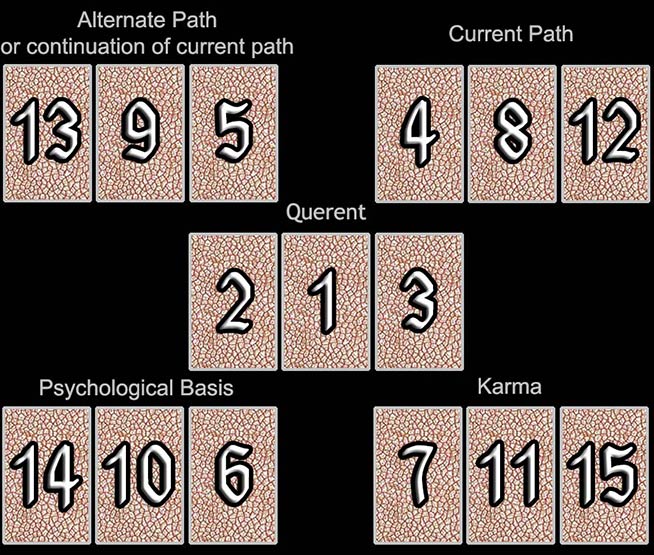
Card #1 represents the querent and the nature of the topic at hand.
Cards #2 & #3 are used in conjunction with #1 to further comprehend the nature of the topic.
Your Golden Dawn Reading
| The Alternate Path (or Extension of Current Path) |
Your Current Path |
|||||
 King of Swords |
 Temperance |
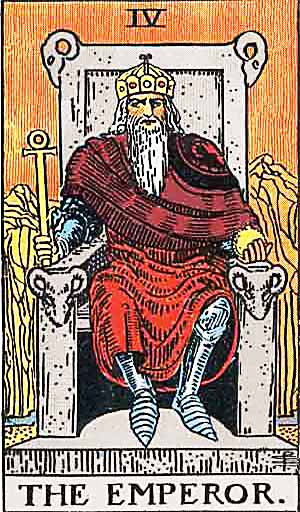 The Emperor |
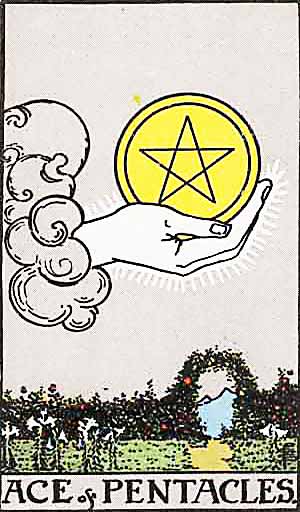 Ace of Pentacles |
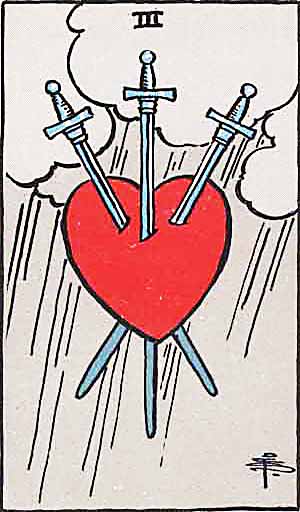 3 of Swords |
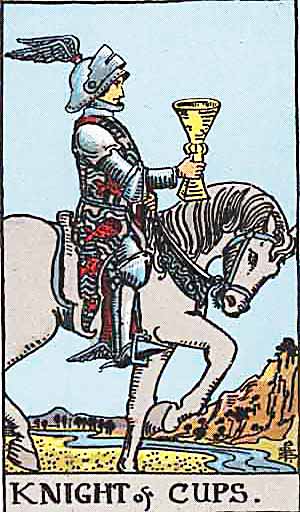 Knight of Cups |
|
| The Querent | ||||||
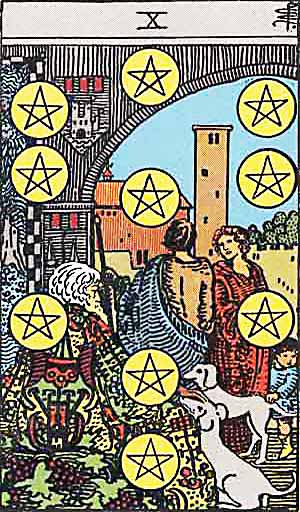 10 of Pentacles |
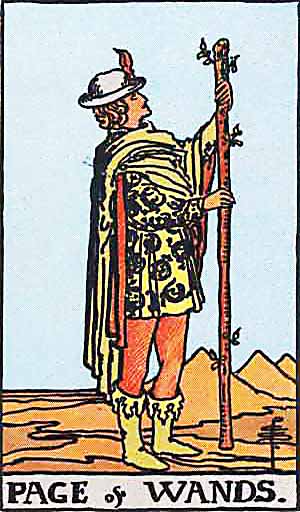 Page of Wands |
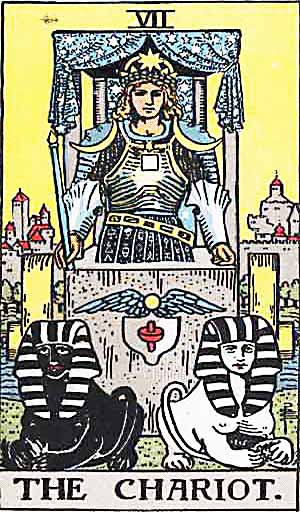 The Chariot |
||||
| The Psychological Basis | Karma | |||||
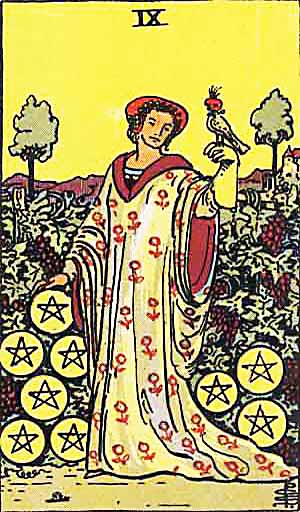 9 of Pentacles |
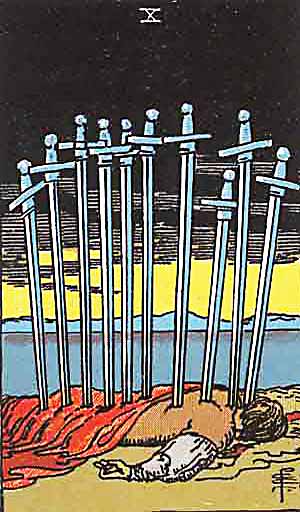 10 of Swords |
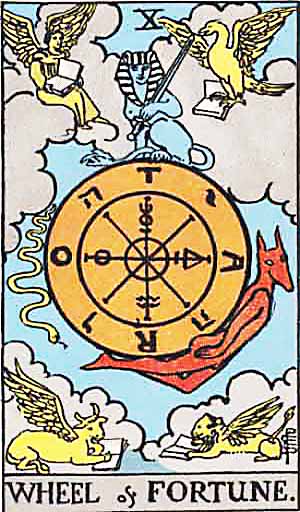 The Wheel of Fortune |
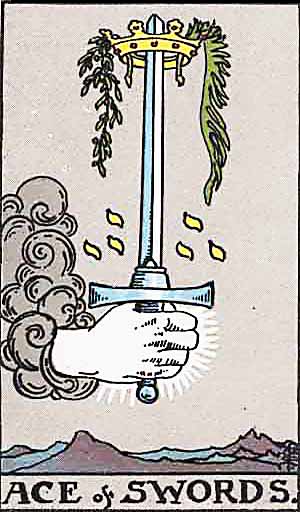 Ace of Swords |
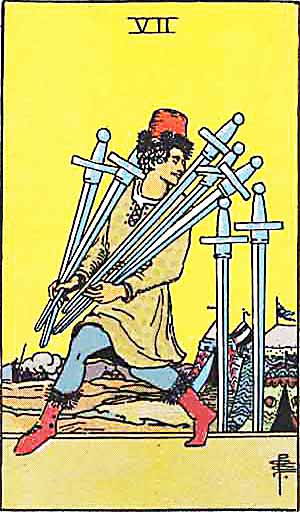 7 of Swords |
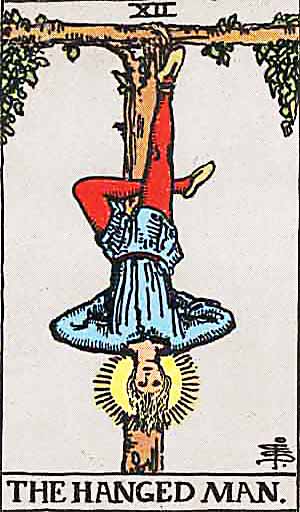 The Hanged Man |
|
This spread is set up to read a certain way with the Court cards. Princes and Queens represent actual men and women connected with the matter, while Princesses generally represent ideas; thoughts or opinions, and Knights represent arrival or departure of a matter depending on the direction faced.
In this spread particular attention should be payed to a card's exact position in relation to its neighbors. Whether the neighbor cards bear the same energy (suit) determines whether a card is considered well- or ill-dignified. Opposite suits ill-dignify each other, while other suits are considered friendly. Cards of the same suit strengthen each other.
Also it is important to count the cards' tendencies, such as whether there is a lot of one particular suit or number pattern. Patterns reveal special messages. Lots of trumps means higher forces at work, lots of cups means strong emotions, etc.
The Querent
cards represent the querent and the nature of the topic at hand. The first card (in the center of the spread) represents the very core of the matter, and the other two cards around it are added to it in order to further comprehend the nature of the topic.
In a scene similar to the former, a young man stands in the act of proclamation. He is unknown but faithful, and his tidings are strange.
Reversed Meaning:
Anecdotes, announcements, evil news. Also, indecision and the instability which accompanies it.
A man and woman beneath an archway which gives entrance to a house and domain. They are accompanied by a child, who looks curiously at two dogs accosting an ancient personage seated in the foreground. The child's hand is on one of them.
Reversed Meaning:
Chance, fatality, loss, robbery, games of hazard; sometimes gift, dowry, pension.
An erect and princely figure carrying a drawn sword and corresponding, broadly speaking, to the traditional description which I have given in the first part. On the shoulders of the victorious hero are supposed to be the Urim and Thummim. He has led captivity captive; he is conquest on all planes – in the mind, in science, in progress, in certain trials of initiation. He has thus replied to the sphinx, and it is on this account that I have accepted the variation of Eliphas Levi; two sphinxes thus draw his chariot. He is above all things triumph in the mind.
It is to be understood for this reason (a) that the question of the sphinx is concerned with a Mystery of Nature and not of the world of Grace, to which the charioteer could offer no answer; (b) that the planes of his conquest are manifest or external and not within himself; (c) that the liberation which he effects may leave himself in the bondage of the logical understanding; (d) that the tests of initiation through which he has passed in triumph are to be understood physically or rationally; and (e) that if he came to the pillars of that Temple between which the High Priestess is seated, he could not open the scroll called Tora, nor if she questioned him could he answer. He is not hereditary royalty and he is not priesthood.
Reversed Meaning:
Riot, quarrel, dispute, litigation, defeat.
Your Current Path
cards represent your current path as it would unfold naturally. These cards are read in chronological order from left to right.
A hand – issuing, as usual, from a cloud – holds up a pentacle.
Reversed Meaning:
The evil side of wealth, bad intelligence; also, great riches. In any case it shews prosperity, comfortable material conditions, but whether these are of advantage to the possessor will depend on whether the card is reversed or not.
Three swords piercing a heart; cloud and rain behind.
Divinatory Meaning:
Removal, absence, delay, division, rupture, dispersion, and all that the design signifies naturally, being too simple and obvious to call for specific enumeration.
Graceful, but not warlike; riding quietly, wearing a winged helmet, referring to those higher graces of the imagination which sometimes characterise this card. He too is a dreamer, but the images of the side of sense haunt him in his vision.
Divinatory Meaning:
Arrival, approach – sometimes that of a messenger; advances, proposition, demeanour, invitation, incitement.
The Alternate Path
cards represent the alternate path that you could choose to take in lieu of the Current Path. However, if the cards that come up seem to indicate that they go along with the Current Path, these three cards should be interpretted not as an Alternate Path, but as a chronological extension of the Current Path (also read from left to right).
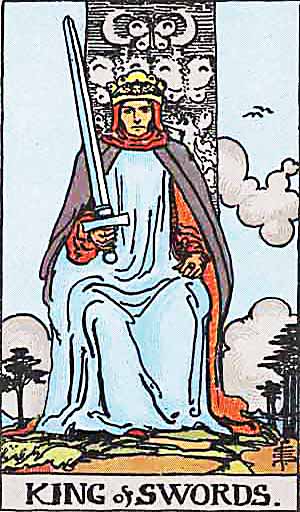
He sits in judgment, holding the unsheathed sign of his suit. He recalls, of course, the conventional Symbol of justice in the Trumps Major, and he may represent this virtue, but he is rather the power of life and death, in virtue of his office.
Reversed Meaning:
Cruelty, perversity, barbarity, perfidy, evil intention.
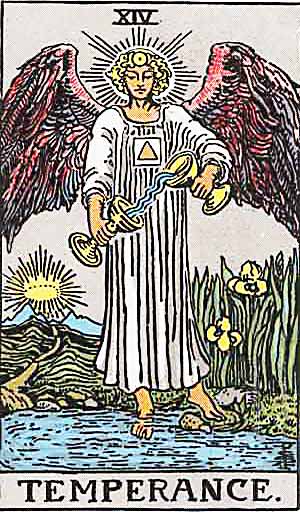
A winged angel, with the sign of the sun upon his forehead and on his breast the square and triangle of the septenary. I speak of him in the masculine sense, but the figure is neither male nor female. It is held to be pouring the essences of life from chalice to chalice. It has one foot upon the earth and one upon waters, thus illustrating the nature of the essences. A direct path goes up to certain heights on the verge of the horizon, and above there is a great light, through which a crown is seen vaguely. Hereof is some part of the Secret of Eternal Life, as it is possible to man in his incarnation. All the conventional emblems are renounced herein.
So also are the conventional meanings, which refer to changes in the seasons, perpetual movement of life and even the combination of ideas. It is, moreover, untrue to say that the figure symbolises the genius of the sun, though it is the analogy of solar light, realised in the third part of our human triplicity. It is called Temperance fantastically, because, when the rule of it obtains in our consciousness, it tempers, combines and harmonises the psychic and material natures. Under that rule we know in our rational part something of whence we came and whither we are going.
Reversed Meaning:
Things connected with churches, religions, sects, the priesthood, sometimes even the priest who will marry the Querent; also disunion, unfortunate combinations, competing interests.
He has a form of the Crux ansata for his sceptre and a globe in his left hand. He is a crowned monarch – commanding, stately, seated on a throne, the arms of which axe fronted by ram heads. He is executive and realisation, the power of this world, here clothed with the highest of its natural attributes. He is occasionally represented as seated on a cubic stone, which, however, confuses some of the issues. He is the virile power, to which the Empress responds, and in this sense is he who seeks to remove the Veil of Isis; yet she remains virgo intacta.
It should be understood that this card and that of the Empress do not precisely represent the condition of married life, though this state is implied. On the surface, as I have indicated, they stand for mundane royalty, uplifted on the seats of the mighty; but above this there is the suggestion of another presence. They signify also – and the male figure especially – the higher kingship, occupying the intellectual throne. Hereof is the lordship of thought rather than of the animal world. Both personalities, after their own manner, are full of strange experience, but theirs is not consciously the wisdom which draws from a higher world. The Emperor has been described as (a) will in its embodied form, but this is only one of its applications, and (b) as an expression of virtualities contained in the Absolute Being – but this is fantasy.
Reversed Meaning:
Benevolence, compassion, credit; also, confusion to enemies, obstruction, immaturity.
The Psychological Basis
cards shed light upon the psychological undertones of the current problem.
A woman, with a bird upon her wrist, stands amidst a great abundance of grapevines in the garden of a manorial house. It is a wide domain, suggesting plenty in all things. Possibly it is her own possession and testifies to material well-being.
Reversed Meaning:
Roguery, deception, voided project, bad faith.
A prostrate figure, pierced by all the swords belonging to the card.
Reversed Meaning:
Advantage, profit, success, favour, but none of these are permanent; also, power and authority.
The four Living Creatures of Ezekiel occupy the angles of the card, and the wheel itself follows other indications of Levi in respect of Ezekiel's vision, as illustrative of the particular Tarot Key. With the French occultist, and in the design itself, the symbolic picture stands for the perpetual motion of a fluidic universe and for the flux of human life. The Sphinx is the equilibrium therein. The transliteration of Taro as Rota is inscribed on the wheel, counter changed with the letters of the Divine Name – to shew that Providence is imphed through all. But this is the Divine intention within, and the similar intention without is exemplified by the four Living Creatures. Sometimes the sphinx is represented couchant on a pedestal above, which defrauds the symbolism by stultifying the essential idea of stability amidst movement.
Behind the general notion expressed in the symbol there lies the denial of chance and the fatality which is implied therein. It may be added that, from the days of Levi onward, the occult explanations of this card are – even for occultism itself – of a singularly fatuous kind. It has been said to mean principle, fecundity, virile honour, ruling authority, etc. The findings of common fortune-telling are better than this on their own plane.
Reversed Meaning:
Increase, abundance, superfluity.
Karma
These cards represent the influences of karma and destiny that are beyond your control. They suggest adapting to this fate.
A hand issues from a cloud, grasping as word, the point of which is encircled by a crown.
Reversed Meaning:
The same, but the results are disastrous; another account says – conception, childbirth, augmentation, multiplicity.
A man in the act of carrying away five swords rapidly; the two others of the card remain stuck in the ground. A camp is close at hand.
Reversed Meaning:
Good advice, counsel, instruction, slander, babbling.
The gallows from which he is suspended forms a Tau cross, while the figure – from the position of the legs – forms a fylfot cross. There is a nimbus about the head of the seeming martyr. It should be noted (1) that the tree of sacrifice is living wood, with leaves thereon; (2) that the face expresses deep entrancement, not suffering; (3) that the figure, as a whole, suggests life in suspension, but life and not death. It is a card of profound significance, but all the significance is veiled. One of his editors suggests that Eliphas Levi did not know the meaning, which is unquestionable nor did the editor himself. It has been called falsely a card of martyrdom, a card of prudence, a card of the Great Work, a card of duty; but we may exhaust all published interpretations and find only vanity. It expresses the relation, in one of its aspects, between the Divine and the Universe.
He who can understand that the story of his higher nature is imbedded in this symbolism will receive intimations concerning a great awakening that is possible, and will know that after the sacred Mystery of Death there is a glorious Mystery of Resurrection.
Reversed Meaning:
Selfishness, the crowd, body politic.