
Cross Spread
Difficulty: Easy
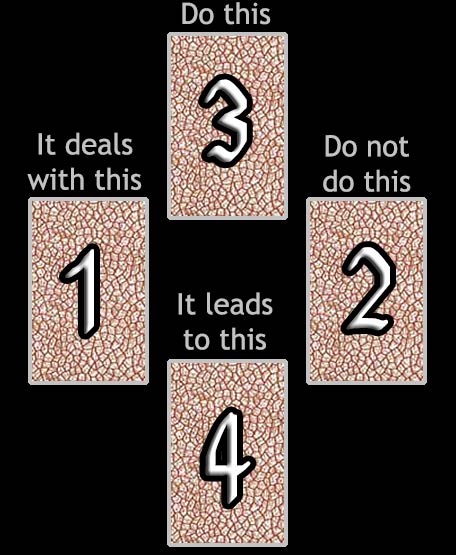
The Cross Spread is good for questions asking for advice. It can also be used to determine the meaning of a confusing card from a previous reading, or for that matter, to shed light on other points of confusion as well.
In questions asking advice, this spread is self-explanatory. The main thing is to determine the difference between cards #2 and #3. #1 is the topic and #4 is the result.
In questions regarding confusion, such as: “What was the meaning of Card (X) in the last spread?” the main thing is also to determine the difference between cards #2 and #3. In this case, Card #2 will show what the card was not referring to, and Card #3 will show what the card really meant. #1 is the topic and #4 represents the purpose it serves.
Your Cross Reading
DO This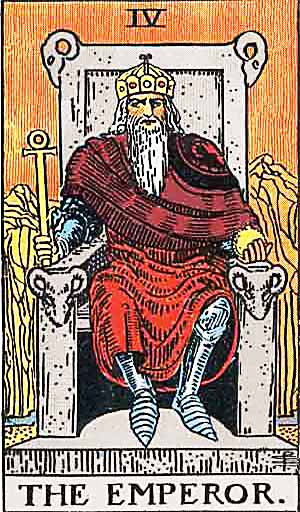 The Emperor |
||
It Deals with This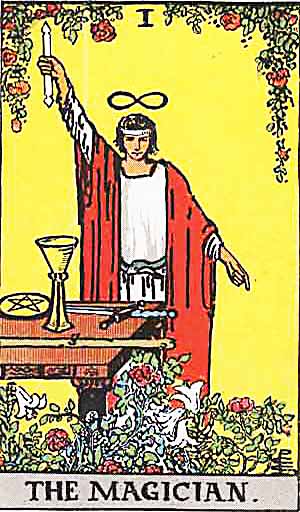 The Magician |
Do NOT Do This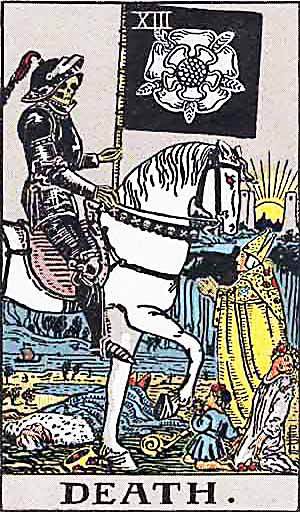 Death |
|
It Leads to This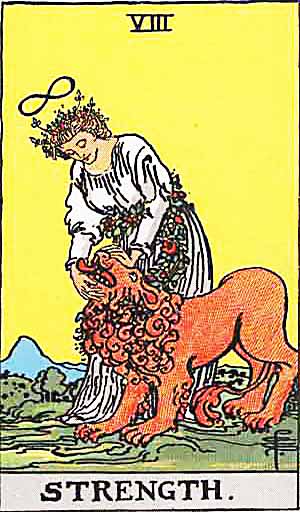 Strength |
It Deals with This
The Magician
A youthful figure in the robe of a magician, having the countenance of divine Apollo, with smile of confidence and shining eyes. Above his head is the mysterious sign of the Holy Spirit, the sign of life, like an endless cord, forming the figure eight in a horizontal position. About his waist is a serpent-cincture, the serpent appearing to devour its own tail. This is familiar to most as a conventional symbol of eternity, but here it indicates more especially the eternity of attainment in the spirit. In the Magician's right hand is a wand raised towards heaven, while the left hand is pointing to the earth. This dual sign is known in very high grades of the Instituted Mysteries; it shews the descent of grace, virtue and light, drawn from things above and derived to things below. The suggestion throughout is therefore the possession and communication of the Powers and Gifts of the Spirit. On the table in front of the Magician are the symbols of the four Tarot suits, signifying the elements of natural life, which lie like counters before the adept, and he adapts them as he wills. Beneath are roses and lilies, the flos campi and lilium convallium, changed into garden flowers, to shew the culture of aspiration. This card signifies the divine motive in man, reflecting God, the will in the liberation of its union with that which is above. It is also the unity of individual being on all planes, and in a very high sense it is thought, in the fixation thereof. With further reference to what I have called the sign of life and its connexion with the number 8, it may be remembered that Christian Gnosticism speaks of rebirth in Christ as a change unto the Ogdoad. The mystic number is termed Jerusalem above, the Land flowing with Milk and Honey, the Holy Spirit and the Land of the Lord. According to Martinism, eight is the number of Christ.
Divinatory Meaning:
Skill, diplomacy, address, subtlety; sickness, pain, loss, disaster, snares of enemies; self-confidence, will; the Querent, if male.
Do NOT Do This
Death
The veil or mask of life is perpetuated in change, transformation and passage from lower to higher, and this is more fitly represented in the rectified Tarot by one of the apocalyptic visions than by the crude notion of the reaping skeleton. Behind it lies the whole world of ascent in the spirit. The mysterious horseman moves slowly, bearing a black banner emblazoned with the Mystic Rose, which signifies life. Between two pillars on the verge of the horizon there shines the sun of immortality. The horseman carries no visible weapon, but king and child and maiden fall before him, while a prelate with clasped hands awaits his end.
There should be no need to point out that the suggestion of death which I have made in connection with the previous card is, of course, to be understood mystically, but this is not the case in the present instance. The natural transit of man to the next stage of his being either is or may be one form of his progress, but the exotic and almost unknown entrance, while still in this life, into the state of mystical death is a change in the form of consciousness and the passage into a state to which ordinary death is neither the path nor gate. The existing occult explanations of the 13th card are, on the whole, better than usual, rebirth, creation, destination, renewal, and the rest.
Reversed Meaning:
Inertia, sleep, lethargy, petrifaction, somnambulism; hope destroyed.
DO This
The Emperor
He has a form of the Crux ansata for his sceptre and a globe in his left hand. He is a crowned monarch – commanding, stately, seated on a throne, the arms of which axe fronted by ram heads. He is executive and realisation, the power of this world, here clothed with the highest of its natural attributes. He is occasionally represented as seated on a cubic stone, which, however, confuses some of the issues. He is the virile power, to which the Empress responds, and in this sense is he who seeks to remove the Veil of Isis; yet she remains virgo intacta.
It should be understood that this card and that of the Empress do not precisely represent the condition of married life, though this state is implied. On the surface, as I have indicated, they stand for mundane royalty, uplifted on the seats of the mighty; but above this there is the suggestion of another presence. They signify also – and the male figure especially – the higher kingship, occupying the intellectual throne. Hereof is the lordship of thought rather than of the animal world. Both personalities, after their own manner, are full of strange experience, but theirs is not consciously the wisdom which draws from a higher world. The Emperor has been described as (a) will in its embodied form, but this is only one of its applications, and (b) as an expression of virtualities contained in the Absolute Being – but this is fantasy.
Reversed Meaning:
Benevolence, compassion, credit; also, confusion to enemies, obstruction, immaturity.
It Leads to This
Strength
A woman, over whose head there broods the same symbol of life which we have seen in the card of the Magician, is closing the jaws of a lion. The only point in which this design differs from the conventional presentations is that her beneficent fortitude has already subdued the lion, which is being led by a chain of flowers. For reasons which satisfy myself, this card has been interchanged with that of justice, which is usually numbered eight. As the variation carries nothing with it which will signify to the reader, there is no cause for explanation. Fortitude, in one of its most exalted aspects, is connected with the Divine Mystery of Union; the virtue, of course, operates in all planes, and hence draws on all in its symbolism. It connects also with innocentia inviolata, and with the strength which resides in contemplation.
These higher meanings are, however, matters of inference, and I do not suggest that they are transparent on the surface of the card. They are intimated in a concealed manner by the chain of flowers, which signifies, among many other things, the sweet yoke and the light burden of Divine Law, when it has been taken into the heart of hearts. The card has nothing to do with self-confidence in the ordinary sense, though this has been suggested – but it concerns the confidence of those whose strength is God, who have found their refuge in Him. There is one aspect in which the lion signifies the passions, and she who is called Strength is the higher nature in its liberation. It has walked upon the asp and the basilisk and has trodden down the lion and the dragon.
Divinatory Meaning:
Power, energy, action, courage, magnanimity; also, complete success and honours.
Reversed Meaning:
Despotism, abuse of power, weakness, discord, sometimes even disgrace.