
Horse Shoe Spread
Difficulty: Easy
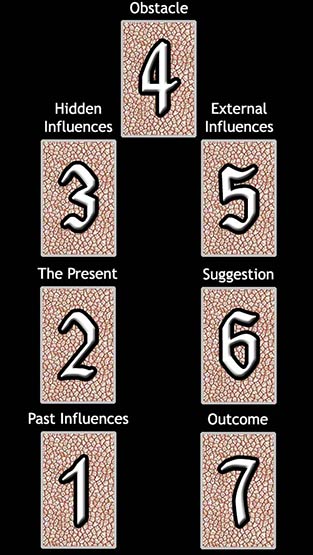
The Horse Shoe is an old classic tarot spread. It is more advanced than the 3-card reading, yet simpler than most other spreads. It is a versatile method that can be used for most queries, though there are other spreads which would go into more depth. Like the simple Past, Present, and Future spread, it contains these cards in positions 1, 2, and 7, but also has 4 other cards that help the reader understand how to deal with the Future better. The cards are to be read as follows:
- The Past: This card represents past events that are affecting the question.
- The Present: This card represents the current state or immediately approaching influence.
- Hidden Influences: Things that you may not be aware of, or barely be aware of.
- Obstacles: This is the challenge. Obstacles might be avoided, or you may have to deal with them.
- External Influences: Attitudes and thoughts about this situation from people around the querent.
- Suggestions: Recommended course of action.
- The Final Outcome: This card represents what would happen if the suggestion is followed.
Your Horse Shoe Reading
Obstacle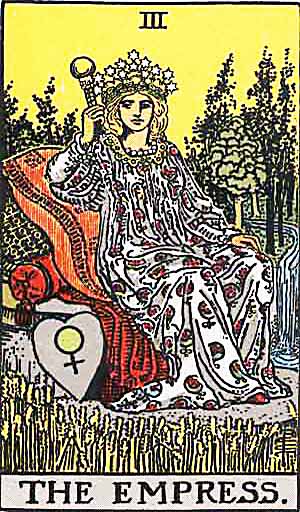 The Empress |
||
Hidden Influences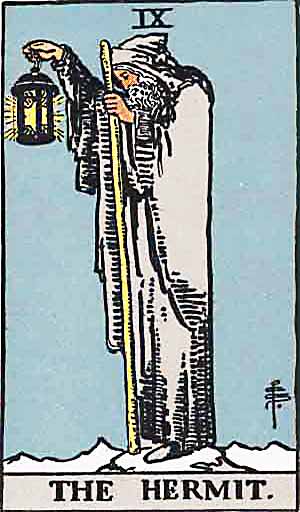 The Hermit |
External Influences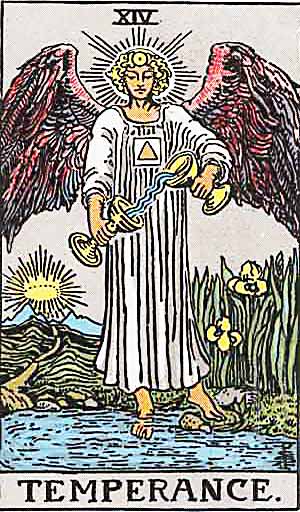 Temperance |
|
The Present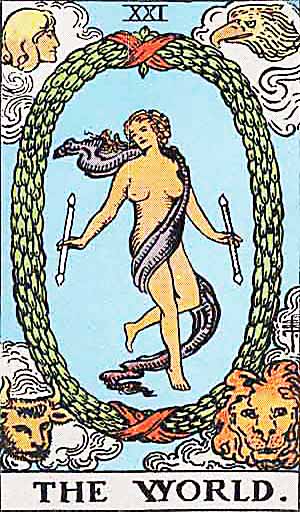 The World |
Suggestion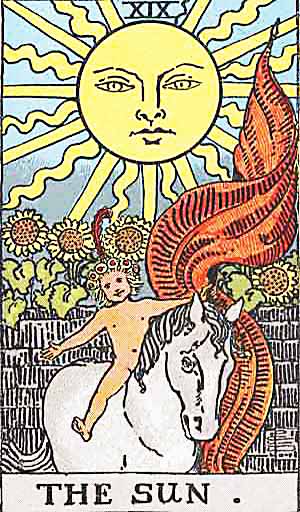 The Sun |
|
The Past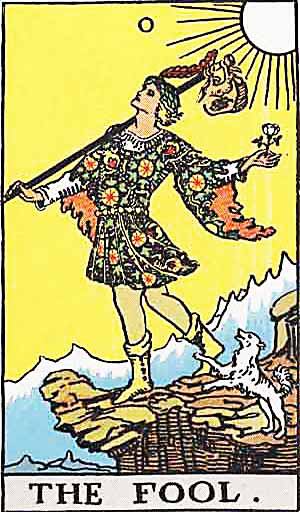 The Fool |
The Outcome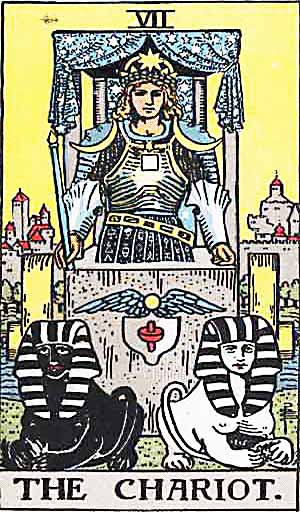 The Chariot |
The Past Card represents past events that are affecting the question.
The Fool
With light step, as if earth and its trammels had little power to restrain him, a young man in gorgeous vestments pauses at the brink of a precipice among the great heights of the world; he surveys the blue distance before him – its expanse of sky rather than the prospect below. His act of eager walking is still indicated, though he is stationary at the given moment; his dog is still bounding. The edge which opens on the depth has no terror; it is as if angels were waiting to uphold him, if it came about that he leaped from the height. His countenance is full of intelligence and expectant dream. He has a rose in one hand and in the other a costly wand, from which depends over his right shoulder a wallet curiously embroidered. He is a prince of the other world on his travels through this one – all amidst the morning glory, in the keen air. The sun, which shines behind him, knows whence he came, whither he is going, and how he will return by another path after many days. He is the spirit in search of experience. Many symbols of the Instituted Mysteries are summarised in this card, which reverses, under high warrants, all the confusions that have preceded it.
In his Manual of Cartomancy, Grand Orient has a curious suggestion of the office of Mystic Fool, as apart of his process in higher divination; but it might call for more than ordinary gifts to put it into operation. We shall see how the card fares according to the common arts of fortune-telling, and it will be an example, to those who can discern, of the fact, otherwise so evident, that the Trumps Major had no place originally in the arts of psychic gambling, when cards are used as the counters and pretexts. Of the circumstances under which this art arose we know, however, very little. The conventional explanations say that the Fool signifies the flesh, the sensitive life, and by a peculiar satire its subsidiary name was at one time the alchemist, as depicting folly at the most insensate stage.
Divinatory Meaning:
Folly, mania, extravagance, intoxication, delirium, frenzy, bewrayment.
The Present Card represents the current state or immediately approaching influence.
The World
As this final message of the Major Trumps is unchanged – and indeed unchangeable – in respect of its design, it has been partly described already regarding its deeper sense. It represents also the perfection and end of the Cosmos, the secret which is within it, the rapture of the universe when it understands itself in God. It is further the state of the soul in the consciousness of Divine Vision, reflected from the self-knowing spirit. But these meanings are without prejudice to that which I have said concerning it on the material side.
It has more than one message on the macrocosmic side and is, for example, the state of the restored world when the law of manifestation shall have been carried to the highest degree of natural perfection. But it is perhaps more especially a story of the past, referring to that day when all was declared to be good, when the morning stars sang together and all the Sons of God shouted for joy. One of the worst explanations concerning it is that the figure symbolises the Magus when he has reached the highest degree of initiation; another account says that it represents the absolute, which is ridiculous. The figure has been said to stand for Truth, which is, however, more properly allocated to the seventeenth card. Lastly, it has been called the Crown of the Magi.
Divinatory Meaning:
Assured success, recompense, voyage, route, emigration, flight, change of place.
Hidden Influences - Things that you may not be aware of, or barely be aware of.
The Hermit
The variation from the conventional models in this card is only that the lamp is not enveloped partially in the mantle of its bearer, who blends the idea of the Ancient of Days with the Light of the World It is a star which shines in the lantern. I have said that this is a card of attainment, and to extend this conception the figure is seen holding up his beacon on an eminence. Therefore, the Hermit is not, as Court de Gebelin explained, a wise man in search of truth and justice; nor is he, as a later explanation proposes, an especial example of experience. His beacon intimates that – where I am, you also may be.
It is further a card which is understood quite incorrectly when it is connected with the idea of occult isolation, as the protection of personal magnetism against admixture. This is one of the frivolous renderings which we owe to Eliphas Levi. It has been adopted by the French Order of Martinism and some of us have heard a great deal of the Silent and Unknown Philosophy enveloped by his mantle from the knowledge of the profane. In true Martinism, the significance of the term Philosophe inconnu was of another order. It did not refer to the intended concealment of the Instituted Mysteries, much less of their substitutes, but – like the card itself – to the truth that the Divine Mysteries secure their own protection from those who are unprepared.
Reversed Meaning:
Concealment, disguise, policy, fear, unreasoned caution.
Obstacle - This is the challenge.
The Empress
A stately figure, seated, having rich vestments and royal aspect, as of a daughter of heaven and earth. Her diadem is of twelve stars, gathered in a cluster. The symbol of Venus is on the shield which rests near her. A field of corn is ripening in front of her, and beyond there is a fall of water. The sceptre which she bears is surmounted by the globe of this world. She is the inferior Garden of Eden, the Earthly Paradise, all that is symbolised by the visible house of man. She is not Regina coeli, but she is still refugium peccatorum, the fruitful mother of thousands. There are also certain aspects in which she has been correctly described as desire and the wings thereof, as the woman clothed with the sun, as Gloria Mundi and the veil of the Sanctum Sanctorum; but she is not, I may add, the soul that has attained wings, unless all the symbolism is counted up another and unusual way. She is, above all things, universal fecundity and the outer sense of the Word. This is obvious, because there is no direct message which has been given to man like that which is borne by woman; but she does not herself carry its interpretation.
In another order of ideas, the card of the Empress signifies the door or gate by which an entrance is obtained into this life, as into the Garden of Venus; and then the way which leads out therefrom, into that which is beyond, is the secret known to the High Priestess: it is communicated by her to the elect. Most old attributions of this card are completely wrong on the symbolism – as, for example, its identification with the Word, Divine Nature, the Triad, and so forth.
Divinatory Meaning:
Fruitfulness, action, initiative, length of days; the unknown, clandestine; also, difficulty, doubt, ignorance.
External Influences - Attitudes about this situation from people around the querent.
Temperance
A winged angel, with the sign of the sun upon his forehead and on his breast the square and triangle of the septenary. I speak of him in the masculine sense, but the figure is neither male nor female. It is held to be pouring the essences of life from chalice to chalice. It has one foot upon the earth and one upon waters, thus illustrating the nature of the essences. A direct path goes up to certain heights on the verge of the horizon, and above there is a great light, through which a crown is seen vaguely. Hereof is some part of the Secret of Eternal Life, as it is possible to man in his incarnation. All the conventional emblems are renounced herein.
So also are the conventional meanings, which refer to changes in the seasons, perpetual movement of life and even the combination of ideas. It is, moreover, untrue to say that the figure symbolises the genius of the sun, though it is the analogy of solar light, realised in the third part of our human triplicity. It is called Temperance fantastically, because, when the rule of it obtains in our consciousness, it tempers, combines and harmonises the psychic and material natures. Under that rule we know in our rational part something of whence we came and whither we are going.
Divinatory Meaning:
Economy, moderation, frugality, management, accommodation.
Suggestion - The recommended course of action.
The Sun
The naked child mounted on a white horse and displaying a red standard has been mentioned already as the better symbolism connected with this card. It is the destiny of the Supernatural East and the great and holy light which goes before the endless procession of humanity, coming out from the walled garden of the sensitive life and passing on the journey home. The card signifies, therefore, the transit from the manifest light of this world, represented by the glorious sun of earth, to the light of the world to come, which goes before aspiration and is typified by the heart of a child.
But the last allusion is again the key to a different form or aspect of the symbolism. The sun is that of consciousness in the spirit – the direct as the antithesis of the reflected light. The characteristic type of humanity has become a little child therein – a child in the sense of simplicity and innocence in the sense of wisdom. In that simplicity, he bears the seal of Nature and of Art; in that innocence, he signifies the restored world. When the self-knowing spirit has dawned in the consciousness above the natural mind, that mind in its renewal leads forth the animal nature in a state of perfect conformity.
Divinatory Meaning:
Material happiness, fortunate marriage, contentment.
The Outcome - What will happen if the suggestion is followed.
The Chariot
An erect and princely figure carrying a drawn sword and corresponding, broadly speaking, to the traditional description which I have given in the first part. On the shoulders of the victorious hero are supposed to be the Urim and Thummim. He has led captivity captive; he is conquest on all planes – in the mind, in science, in progress, in certain trials of initiation. He has thus replied to the sphinx, and it is on this account that I have accepted the variation of Eliphas Levi; two sphinxes thus draw his chariot. He is above all things triumph in the mind.
It is to be understood for this reason (a) that the question of the sphinx is concerned with a Mystery of Nature and not of the world of Grace, to which the charioteer could offer no answer; (b) that the planes of his conquest are manifest or external and not within himself; (c) that the liberation which he effects may leave himself in the bondage of the logical understanding; (d) that the tests of initiation through which he has passed in triumph are to be understood physically or rationally; and (e) that if he came to the pillars of that Temple between which the High Priestess is seated, he could not open the scroll called Tora, nor if she questioned him could he answer. He is not hereditary royalty and he is not priesthood.
Reversed Meaning:
Riot, quarrel, dispute, litigation, defeat.